Several million people in the United States are impacted by Spanish to English translation daily. You may be a student who wants to attend American universities, a professional who wants to get work authorization, an immigrant who wants to become a citizen, or an NRI who wants to keep in touch with relatives; you have to have proper translations that are up to official standards.
Here, you will know all about professional Spanish to English translation, how to make a translation certified, and how to select the appropriate service provider to meet your particular requirements. You will also know about pricing, turnaround times, most frequent errors, and real-life examples of situations when professional translation can ensure success or failure.
What Is Spanish to English Translation?
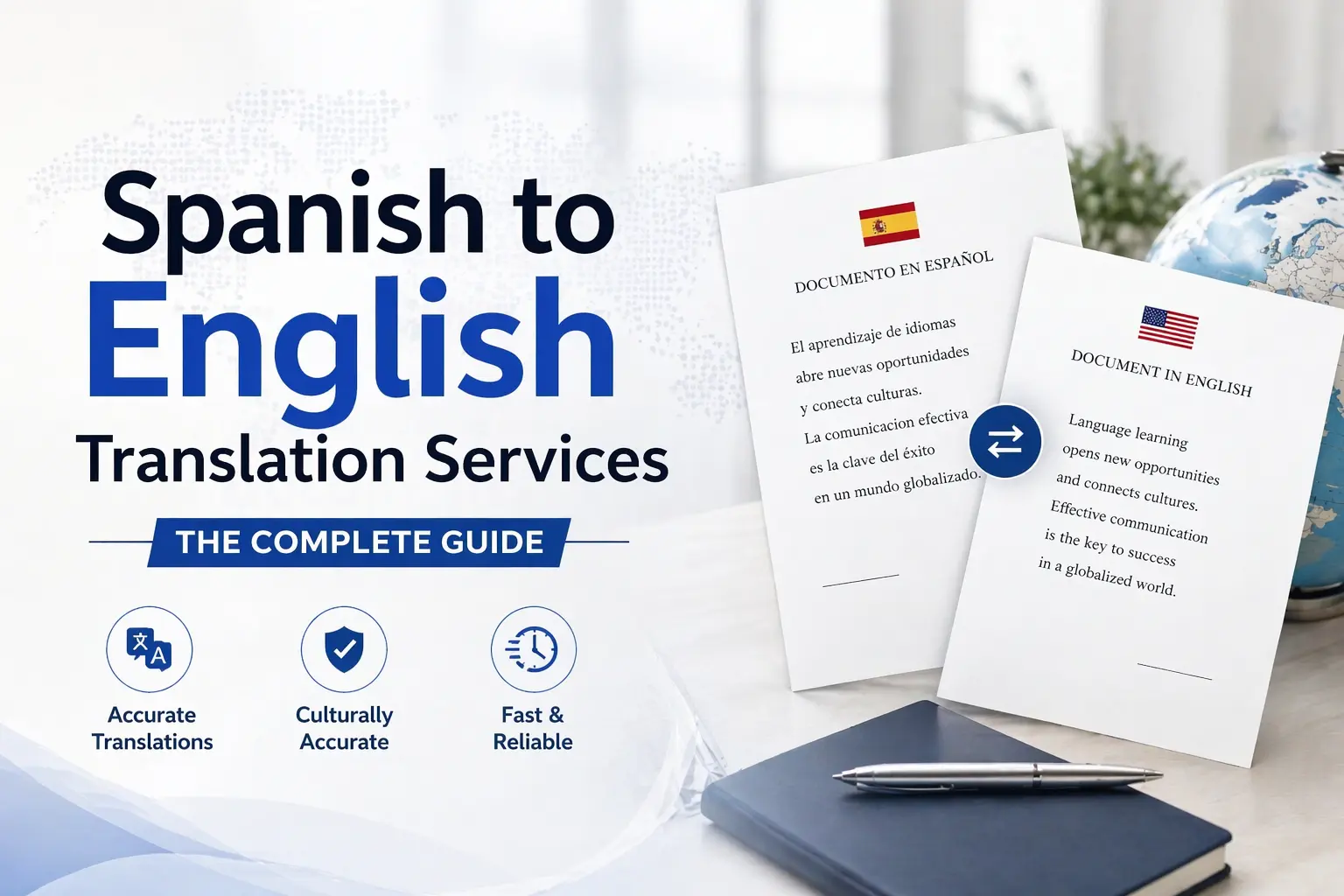
Spanish to English translation translates written Spanish into readable English that is precise to the meaning, tone, and intent of the original Spanish text. This is much more than mere word replacement; it involves a thorough knowledge of both languages, culture, and the purpose of the document.
Translation is quite a different thing from interpretation. Translation is concerned with written papers – birth certificates, diplomas, contracts, and medical records. Interpretation is used in real-time scenarios, such as in a courtroom, during a medical appointment or during a business meeting to interpret the spoken language. Each requires a variety of skills and certifications.
Key differences:
- Translation: Written documents, time for research and revision, permanent record
- Interpretation: Spoken communication, immediate response required, no written output
In the United States, there are about 41.8 million Spanish speakers, and it is the second-largest Spanish speaking nation in the world. This huge Spanish-speaking community poses incessant pressure on professional Spanish to English translation services in all the sectors, such as education, medical, legal, business, and government.
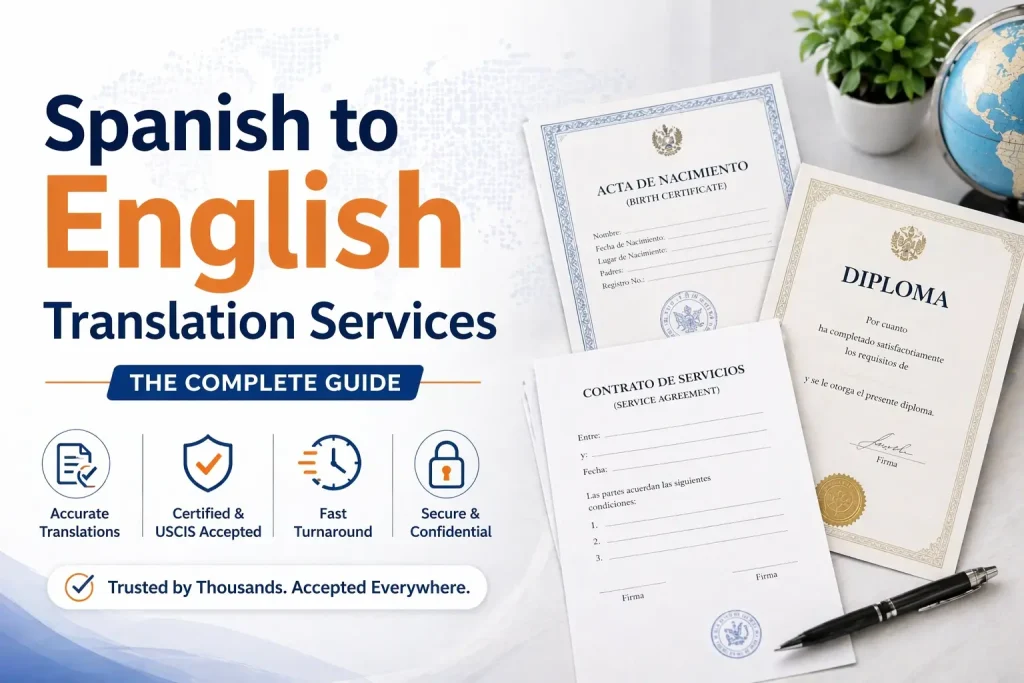
Why Professional Spanish to English Translation Matters
You would have assumed that your documents could be handled by bilingual friends or online translation software. This assumption is very problematic, which costs you time, money, and opportunities.
Professional translation is important as accuracy is what counts. An application containing a poor translation is denied by USCIS. Institutions reject applications when the transcripts are not up to the mark. Evidence that has uncertified translations is thrown out by courts. Employers doubt credential not duly documented.
The Spanish language is the fourth most translated language in the world, with a high amount of translation in law, medical, technical, and business fields. This is due to the high demand since Spanish-speaking countries have distinct legal systems, education systems, and document formats as compared to the United States.
Why professional services matter:
- Legal compliance with federal and state requirements
- Understanding of technical and legal terminology
- Knowledge of cultural context and regional variations
- Quality control through multiple review stages
- Proper certification that authorities accept
- Liability protection if errors occur
Machine translation tools like Google Translate work for casual communication, but they fail catastrophically with official documents. They miss context, mistranslate legal terms, ignore cultural nuances, and can’t provide the certification you need for official purposes.
Types of Spanish to English Translation Services
Different situations require different types of Spanish to English translation services. Understanding these categories helps you choose the right service for your needs.
Certified translation:
Documents that need certifications by USCIS, courts, universities, or government agencies. The translator gives a signed testimony of accuracy and completeness. This is what you require in immigration applications, educational credentials and in legal cases.
Sworn translation:
Applied in certain legal settings in which the translator swears in the presence of a notary or other court officer. International legal cases are sometimes necessitated by this and are more frequently used in Spanish-speaking nations than in the United States.
Technical and scientific translation:
Preparing engineering reports, scientific research, technical manuals and patent applications. Needs translators who are subject matter experts and are familiar with specialised lingo in both languages.
Medical translation:
Medical reports, patient records, clinical trial records, pharmaceutical information and healthcare forms. Requires understanding of medical terms and patient privacy (HIPAA).
Legal and court translation:
Contracts, court decisions, depositions, legal briefs, and immigration documents. Needs knowledge of Spanish-speaking and the United States legal systems.
Business and marketing translation:
Corporate documents, marketing material, websites and business correspondence. Needs cultural adaptation to resonate with English-speaking audiences while maintaining brand voice.
Literary translation/creative translation:
Books, articles, creative work, and sales writing. Needs artistic ability to maintain style, tone, and emotion across languages.
Each type demands different expertise. The translator handling your birth certificate needs different skills than someone translating your company’s marketing materials.
Challenges in Spanish to English Translation
Spanish to English translation presents unique challenges that make professional expertise essential. Understanding these challenges helps you appreciate why quality translation costs what it does.
- Cultural nuances:
The cultures of Spanish-speaking countries are widely different and are located on different continents. Mexican Spanish can be compared to Argentine Spanish, which can be compared to Spanish in Spain. Professional translators are knowledgeable of these regional differences and make translations accordingly.
- Differences in grammar and syntax:
Spanish and English sentences are formed in different ways. Spanish has gendered nouns, uses different conjugations of the verb, and has word order flexibility. Direct translation will result in poor English. Professional translators reorganise the sentences so that they sound natural but still maintain the meaning.
- Slang and idioms:
Spanish phrases are not direct translations. To daydream means to be in the clouds (ester en las nubes), not to be floating. Costar un ojo de la cara (to cost an eye of the face) is very expensive. Professional translators identify similar expressions in English which have the same meaning.
- Contextual meaning:
Numerous Spanish words have more than one English translation that varies according to the situation. Derecho may have the sense of right (direction), right (entitlement), law, or straight. Human translators who get it right are only those who have background knowledge.
- Formatting issues:
Dates, numbers, and currencies format differently. Spanish uses periods where English uses commas in numbers (1.000.000 vs 1,000,000). Dates reverse (15/03/2025 vs 03/15/2025). Professional translators handle these details correctly.
The global language services market reached $76.23 billion in 2025, with Spanish translation representing a significant portion due to its widespread use in business, legal, and immigration contexts.
Certified vs Non-Certified Spanish to English Translation
Understanding the difference between certified and non-certified translation helps you know what you actually need.
- What makes a translation “certified”?
A certified translation includes a signed statement from the translator or translation company confirming the translation is complete and accurate. The certification includes the translator’s name, signature, contact information, and date. This statement makes the translator legally accountable for accuracy.
USCIS requires certified translations for all foreign language documents under 8 CFR 103.2(b)(3). The translator must be competent in both languages, but doesn’t need specific credentials from translation organisations.
- When non-certified translation works:
Personal correspondence, casual business emails, internal company documents, and general information don’t require certification. Non-certified translation costs less and delivers faster because it skips the certification process.
Benefits of certification:
- Legal acceptance by government agencies
- University recognition for academic credentials
- Court admissibility for legal proceedings
- Professional credibility for licensing boards
- Peace of mind knowing your documents meet requirements
You can’t upgrade a non-certified translation to certified after the fact. If you need certification, request it from the start.
When and Where You Need Certified Spanish to English Translations
Specific situations absolutely require certified Spanish to English translation services. Submitting non-certified translations in these contexts causes automatic rejection.
- Immigration and visa papers:
Birth certificates, marriage certificates, divorce decrees, police clearance certificates, military records and any document to prove your immigration application. USCIS will not accept unqualified translations in any way.
- Transcripts and diplomas:
College applications, credential checks, professional licensing and job checks will all need certified translations of your academic papers. Universities must confirm that your coursework is appropriate.
- Court and legal documents:
Contracts, judicial decisions, depositions, law dealings, and evidence presented in a court of law. To guarantee a high level of accuracy and responsibility among translators, the courts demand certified translations.
- Government paperwork:
Applications for driving licenses, social security, tax returns, and government forms. There are stringent translation requirements at the state and federal agencies.
- Technical and patent applications:
Technical specifications, patent application, and regulatory submissions. Foreign language documents must be certified by the USPTO and FDA.
Over 72% of multinationals rely on multilingual services to conduct international business, and Spanish is one of the most commonly translated languages.
How Spanish to English Translation Works (Step-by-Step)
Understanding the translation process helps you prepare properly and know what to expec
- Step 1: Document submission
You upload your Spanish documents securely through the provider’s website or email them directly. Include any specific instructions about formatting, terminology preferences, or deadline requirements.
- Step 2: Initial review
A project manager reviews your documents to assess complexity, word count, and special requirements. They provide a quote, estimated turnaround time, and confirm whether certification or notarization is needed.
- Step 3: Translation
A qualified translator fluent in both Spanish and English translates your document word-for-word. They maintain original formatting, translate all text, including stamps and handwritten notes, and use appropriate terminology for your document type.
- Step 4: Editing and proofreading
A second linguist reviews the translation for accuracy, grammar, spelling, and consistency. This quality control step catches errors and ensures the translation reads naturally in English.
- Step 5: Certification and notarization
For certified translations, the translator prepares a certification statement with their signature and contact information. If notarization is required, the document goes to a notary public for official witnessing.
- Step 6: Delivery
You receive your completed translation via email as a PDF, with physical copies mailed if requested. The translation includes the original Spanish document, English translation, and certification statement.
Professional services complete most standard documents within 24-48 hours. Complex or lengthy documents may take longer depending on technical difficulty and word count.
Pricing & Turnaround Time for Spanish to English Translations
Understanding translation pricing helps you budget appropriately and avoid surprise costs.
Typical price ranges:
Standard certified Spanish to English translation typically costs around $16 per page for documents with standard formatting and common terminology. A “page” usually means 250-300 words of source text.
Factors influencing cost:
- Document complexity and technical terminology
- Formatting requirements and special layouts
- Certification and notarization needs
- Turnaround time requirements
- Document length and word count
- Subject matter expertise required
Rush service pricing:
Urgent translations requiring 24-hour or same-day turnaround typically cost around $26 per page. Rush pricing reflects the need to prioritise your project and potentially assign multiple translators to complete it faster.
Standard turnaround times:
- 1-2 pages: 24 hours
- 3-5 pages: 24-48 hours
- 6-10 pages: 2-3 days
- 10+ pages: 3-5 days
These timelines assume standard documents without unusual complexity. Technical documents, legal contracts, or materials requiring subject matter expertise may take longer.
The translation services market continues growing, with businesses increasingly recognising that professional translation isn’t optional—it’s essential for compliance and success.
How to Choose the Best Spanish to English Translation Agency
Choosing the right translation provider affects your results significantly. Not all services deliver the same quality or meet official requirements.
What to look for:
- Experience with your document type matters more than general translation experience. A provider specialising in immigration documents understands USCIS requirements better than a general translation service.
- Native English speakers should handle the English side of your translation. While the translator must understand Spanish perfectly, they should write in English as a native speaker to ensure natural, clear translations.
- Quality control processes separate professional services from amateur ones. Look for providers using multiple review stages, not just single-translator workflows.
- Clear pricing without hidden fees shows professionalism. You should know exactly what you’re paying before work begins, with no surprise charges for certification or formatting.
- Customer reviews from people with similar needs provide valuable insight. Look for reviews mentioning your specific document type and use case.
Red flags to avoid:
- Prices significantly below market rates
- No information about translator qualifications
- Promises of instant or unrealistic turnaround times
- Unwillingness to provide sample certifications
- Poor communication or unclear processes
Common Mistakes to Avoid in Spanish to English Translation
Avoiding these common mistakes saves you time, money, and frustration.
- Official documents should be translated using machine translators:
Official documents do not work with Google Translate and other tools. They are out of context, translate legal terms incorrectly, and cannot certify. Any machine-translated documents are promptly rejected by USCIS and other agencies.
- Hiring unqualified translators:
Your neighbour or colleague who is bilingual may speak both languages, but translating takes certain skills. Professional translators are aware of terminologies, formatting, and certification.
- Not requesting certification beforehand:
Certification cannot be added to a translation that has been done. When you require certification, demand it initially so that you do not pay twice.
- Not providing context:
Indicate the purpose of the document to your translator. Being aware of whether it is USCIS, the university, or the court will assist them in formatting and certifying it properly.
- Ignoring formatting requirements:
Certain agencies have certain formatting, paper, or layout requirements. Before placing an order to translate, check the requirements, or you will be rejected.
- Choosing the cheapest option:
The quality of translation is very different. The most inexpensive supplier tends to give poor quality, which will be rejected, and this means more to you in resubmission and delays.
Why Choose USCIS Translation Services
USCIS Translation Services specialises in Spanish to English translation for immigration, academic, legal, and professional purposes.
- Native Spanish and English speakers:
You get translators who grew up speaking Spanish and write English at a native level. This combination ensures an accurate understanding of your Spanish documents and natural, clear English translations.
- USCIS compliance expertise:
Every translation meets federal requirements for immigration applications. Proper certification statements, correct formatting, and complete translations that USCIS accepts without question.
- Fast turnaround without quality compromise:
Most documents are completed within 24-48 hours. Rush services available when you’re facing tight deadlines. Quality control is maintained regardless of the timeline.
- Multiple document types:
Birth certificates, marriage certificates, divorce decrees, academic transcripts, diplomas, court documents, contracts, medical records, and business documents. Experience with every common document type.
- Secure handling:
Your personal documents receive encrypted transmission, secure storage, and confidential handling. Compliance with data protection regulations and privacy standards
Real Use Cases / Case Studies
Real situations show how professional Spanish to English translation makes the difference between success and failure.
- Case 1: Student visa approval
Maria needed her Mexican university transcripts translated for graduate school admission in the United States. She initially used a cheap online service that provided a basic translation without proper certification. The university rejected her application because the translation didn’t meet their requirements.
She then used USCIS Translation Services for a certified translation. The translator understood the Mexican educational system, properly converted grades to the American scale, and provided certification that the university accepted. Maria gained admission and started her program on time.
- Case 2: Green card application success
Carlos applied for a green card based on marriage to a U.S. citizen. His birth certificate, marriage certificate, and police clearance from Colombia all required certified translation. He tried using a bilingual friend to save money, but USCIS issued a Request for Evidence (RFE) because the translations lacked proper certification.
He obtained certified translations from a professional service. The new translations included proper certification statements with the translator’s credentials and signature. USCIS accepted the documents and approved his green card application without further delays.
- Case 3: Professional licensing
Dr. Hernandez, a physician trained in Argentina, needed his medical degree and transcripts translated for medical licensing in Texas. The Texas Medical Board has strict requirements for foreign credential translations.
He used a professional medical translation service familiar with both Argentine medical education and Texas licensing requirements. The translator properly formatted the documents, explained the Argentine grading system, and provided certification that the medical board accepted. Dr. Hernandez obtained his license and now practices in Houston.
- Case 4: Court case evidence
A law firm needed Spanish business contracts translated for a commercial dispute. The contracts contained complex legal terminology and regional business expressions from Spain. They initially tried using an in-house bilingual paralegal, but opposing counsel challenged the translation’s accuracy.
They hired a professional legal translator with expertise in Spanish commercial law. The certified translation withstood legal scrutiny, and the court admitted it as evidence. The case proceeded without translation-related delays.
These cases show that professional translation isn’t just about converting words—it’s about meeting specific requirements, understanding context, and providing documentation that authorities accept.
Conclusion
Spanish-English translation influences your success in immigration applications, college admissions, professional licensing, and lawsuits. Your translation is what will make your documents be accepted or rejected by authorities.
Professional translation services are accurate, certified and in line with official requirements. Machine translation and amateur translators are cheaper in the short run but lead to costly issues in the form of rejections, delays, and resubmissions.
Key takeaways:
- Always use certified translation for official documents
- Choose translators with experience in your specific document type
- Verify certification meets requirements for your intended use
- Budget appropriately for professional quality
- Allow adequate time for proper translation and review
Your documents deserve professional handling that ensures acceptance the first time.
Get Started With Professional Spanish to English Translation
USCIS Translation Services specialises in certified Spanish to English translation for immigration, academic, legal, and professional purposes. You get native speakers, USCIS compliance, fast turnaround, and transparent pricing.
Ready to get your Spanish documents translated professionally? Visit USCIS Translation Services for certified Spanish to English translation that meets every official requirement. Request your free quote today and ensure your documents receive the professional handling they deserve.
FAQs on Spanish to English Translation Services
Q1. How long does Spanish to English translation take?
Most standard documents take 24-48 hours for professional translation. Simple one-page documents like birth certificates are often completed within 24 hours. Complex multi-page documents may require 2-5 days, depending on technical difficulty and word count. Rush services can deliver same-day translation for urgent needs at higher rates.
Q2. Do I need a certified translation for USCIS documents?
Yes, USCIS requires certified translation for all foreign language documents under 8 CFR 103.2(b)(3). The translator must provide a signed statement confirming the translation is complete and accurate. The translator must be competent in both languages but doesn’t need specific organisational credentials. Non-certified translations get rejected automatically.
Q3. How much does Spanish to English translation service cost?
Professional certified translation typically costs $16 per page, depending on turnaround time and complexity. Standard service runs about $16 per page with 24-48 hour delivery. Rush service costs around $26 per page for same-day or 24-hour turnaround. Technical or legal documents may cost more due to the specialised expertise required.
Q4. Can I translate my own documents for USCIS?
No, you cannot translate your own documents for USCIS applications. While USCIS doesn’t technically prohibit self-translation, they can question the validity or consider it biased. Immigration attorneys strongly recommend using professional translators to avoid complications. Family members also shouldn’t translate documents to prevent bias concerns and ensure acceptance.