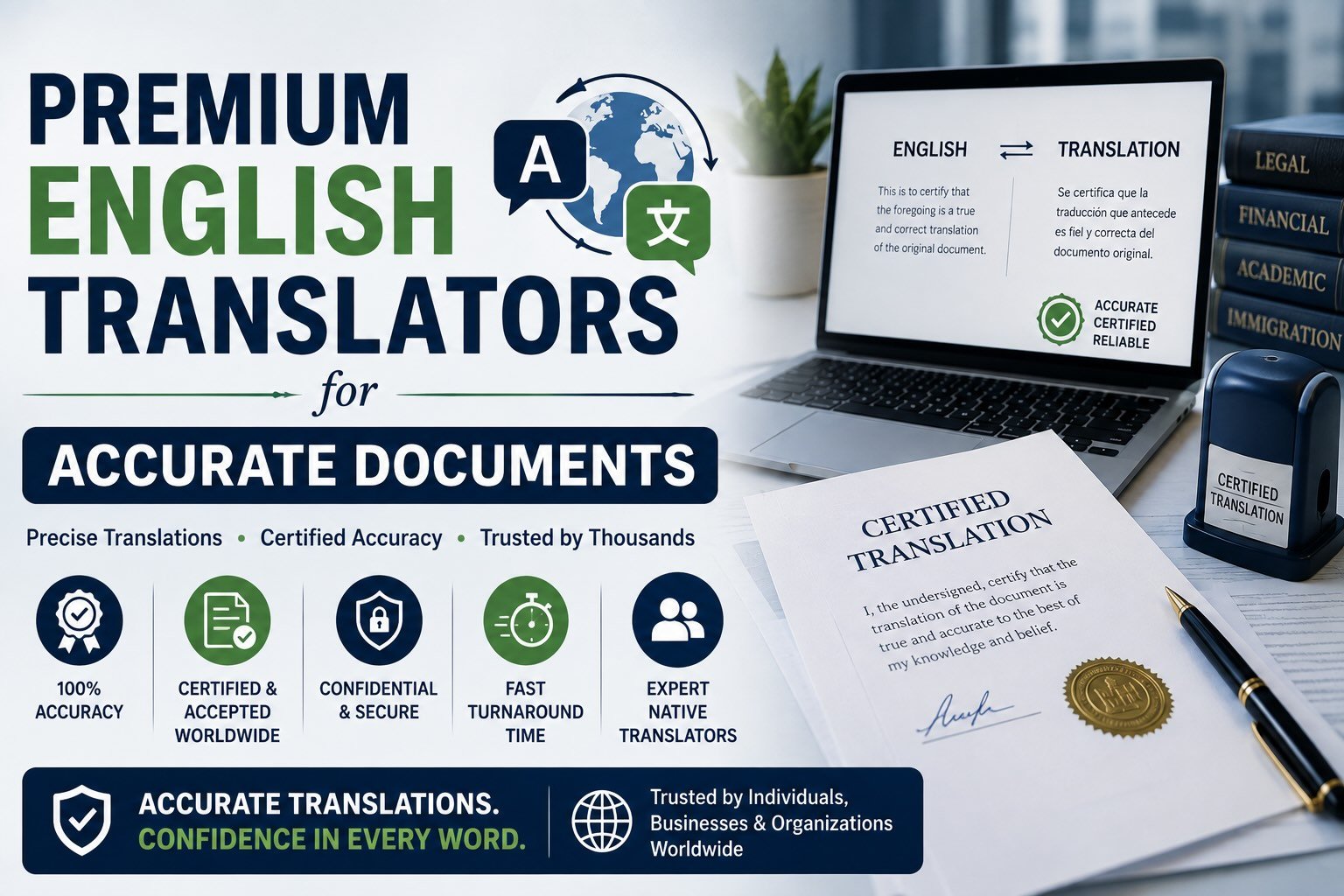
Premium English Translators for Accurate Documents
Finding a premium English translator that delivers accurate results for your academic, professional, or official documents can be tough. You’re not alone. Many students, professionals, and NRIs face challenges when choosing translation tools that balance speed, accuracy, and reliability.
But with the right approach, you can reshape your translation experience from frustrating to flawless. You might need the best online translator for quick conversions. Or Polish translation services for official documents. Or approved translation services for USCIS requirements. Knowing how to use these tools makes all the difference.
Here, we will walk you through everything from simple translation features to advanced techniques. It helps you become skilled at premium translation services and find them when you need them most.
What Premium English Translators Can Do
Understanding what a premium English translator can handle helps you choose the right service for your specific needs. Modern translation solutions offer capabilities way beyond simple word-for-word conversions.

- Translation vs. Interpretation
Translation and interpretation serve different communication purposes. Translators work with written materials only, while interpreters handle spoken language in real-time scenarios. Document translation gives you extensive time to research terminology and ensure accuracy. Interpretation just needs immediate conversion during live conversations, meetings or conferences.
Your choice between these services depends on the situation. Translation requires solid reading comprehension and target language production skills. Interpretation needs a sharp working memory to render content quickly without external resources. Professional translators use computer-assisted tools, translation memory, and termbases during their work. Interpreters rely on exceptional listening skills and knowing how to work under pressure with limited support.
- Real-Time Translation Features
Real-time translation breaks language barriers during conversations instantly. Google Translate now provides back-and-forth conversations in over 70 languages with audio and on-screen translations. The system identifies conversational pauses, accents, and intonations to switch between languages smoothly.
Premium services offer real-time AI translation in 130+ languages. They combine speech-to-text, instant text translation, and text-to-speech at the same time. These features work across Android, iOS, and web platforms while maintaining GDPR compliance without storing personal data.
- Industry-Specific Translation Tools
Technical translation handles complex documents where accuracy is non-negotiable. These specialized tools preserve structured formats such as XML and DITA files and maintain consistent terminology across industries. They support automated publishing workflows.
Professional services match translators with subject-matter expertise to your content type. Medical reports, legal contracts, and engineering manuals require translators who understand terminology beyond general language proficiency. This specialization ensures precision for safety-critical and compliance-sensitive documents.
Step-by-Step Guide to Using Translation Tools
Becoming skilled at translation tools requires systematic steps that ensure accuracy and efficiency. Each phase builds upon what came before to deliver professional results.
1. Choose Your Translation Method
Four main translation methods exist. Each produces different outcomes in quality, speed, and cost. Machine translation delivers instant, free results but produces patchy quality with unclear wording and potential errors. Machine translation plus human revision (MTPE) fixes grammatical errors and unclear wording. We use it for information purposes. Human translation produces publishable-standard results with excellent expression quality. Human translation plus revision achieves the highest quality through original translation followed by a second translator’s review.
2. Input Your Text Correctly
Write your content in Global English before translation. Use shorter sentences and clear language. Appropriate references make the translator’s work easier. Create short paragraphs. This generates smaller strings and better translation memory usage. Hard returns always create new strings and potentially split sentences incorrectly. Use soft returns (shift + enter) instead. This keeps content as full strings while maintaining visual breaks.
3. Select Language Pairs
Language pairs indicate your source and target languages. A language pair forms when one language translates into another, such as English-Spanish. Specify language pair settings in project options or during project creation. You have multiple language pairs? Select translation memories at the All Language Pairs level. This applies them across all contained pairs.
4. Review Output Quality
Translation quality spans from low-quality machine output to high-quality professional human translations. Human reviewers assess accuracy, fluency, cultural appropriateness, consistency and readability. Translation memory tools store previously translated segments for reuse and maintain terminology and style consistency.
5. Make Adjustments
Post-editing bridges automated speed and quality. Light post-editing ensures understandable, accurate text free of major errors. You can use it for internal documents. Full post-editing produces publishable, high-quality text indistinguishable from human translation. You need it for marketing materials and user interfaces.
6. Save and Export Your Translation
Export translation sheets as CSV files. These contain default language and empty cells for translator updates. Select individual languages or export all translation sheets at once. Import completed CSV files and choose whether to overwrite existing translations or add only new content.
Advanced Features and Best Practices
Premium translation platforms discover advanced capabilities that separate casual users from professionals who just need precision and efficiency.
- Using Translation Memory
Translation Memory functions as a database. It stores sentence pairs with matching source and target segments. The system suggests translations as you work and shows similarity with percentages where 100% represents perfect matches. This technology speeds up your workflow. It maintains consistency and increases quality. You benefit from faster delivery and reduced costs. Accuracy improves since translators focus on new content rather than retranslating similar segments.
- AI and Machine Learning
Neural Machine Translation uses deep learning to detect patterns in sentence structure, intent and word relationships. Machine learning improves translations through user corrections and feedback. It refines stored data over time. Standard translation software incorporates AI to understand context for accurate translations.
- Integration with Other Tools
Connect your content management system to automate website localization through integrations. API access makes systems able to communicate using REST or SOAP architecture standards. Automated translation workflows eliminate tasks and reduce errors while managing multilingual content from your dashboard.
- Large Translation Projects
A centralized TMS tracks progress across multiple languages and stores translated content via translation memories. It manages terminology glossaries. Apply risk-based testing models. Focus review on high-impact content like onboarding flows and checkout processes. When handling official documentation that requires certified accuracy, approved translation services ensure compliance with legal standards.
Finding Approved Translation Services for Official Documents
Official documents require certified translations that meet strict institutional standards. Your choice of translation service is critical to acceptance.
- Requirements for Certified Translations
A certified translation has a formal Certificate of Accuracy signed by the translator or company. This attests to complete accuracy. Federal regulations state that any foreign language document submitted to USCIS must have a full English translation with the translator’s certification of competence. The certificate must contain the translator’s qualifications statement and accuracy declaration. It must also identify source and target languages and include the translator’s full name, signature, and translation date.
Certification is different from notarization. Certification attests to translation accuracy and comes from the translation provider. Notarization verifies the signer’s identity through a Notary Public.
- Working with Professional Translation Agencies
Select agencies with American Translators Association membership. This shows commitment to industry standards. ATA represents the only official certification agency in the United States. It is recognized worldwide with strict testing requirements. Professional agencies employ multiple quality checks through proofreaders and editors. This reduces errors before delivery.
- Comparing Online vs. Traditional Services
Local translation shops understand specific regional requirements better than generic online services. They know what USCIS approved premium English translators and legal documents are needed. Online platforms offer faster turnaround and potentially lower costs based on location.
- Cost vs. Quality Considerations
Noncertified translation appears cheaper at first. It costs USD 879.00 versus USD 6,069.00 for certified services. Error correction added USD 4,651.00 to noncertified costs, but Total expenses for similar work reached USD 5,530.00 for noncertified versus USD 6,070.00 for certified services. This proves a minimal difference after quality adjustments.
- Special Considerations for Polish Translation Services
Polish consular offices translate documents between Polish and English at 141 USD per page or 71 USD for repetitive content. They complete translations within 30 days. Professional agencies charge USD 39.00 per page for certified Polish-to-English translations. They deliver simple 1-3 page documents in 3-5 business days.
Explore professional translation services that guarantee acceptance for reliable certified translations meeting USCIS standards.
Conclusion
You now have everything you need to use premium English translator tools and choose certified services when accuracy matters most. Modern platforms offer excellent speed and convenience for quick translations. But official documents for USCIS, academic submissions, or legal purposes require certified accuracy. You must select professional translation services that guarantee acceptance and compliance. This ensures your documents meet institutional standards without rejections or delays that can get pricey.
General FAQs
Q1. What are the key principles for achieving high-quality translations?
The fundamental principles include ensuring accuracy to the original text’s meaning, maintaining clarity so the translated content is easy to read and understand, and preserving consistency throughout the document. Professional translators also focus on cultural appropriateness and readability to ensure the translation serves its intended purpose effectively.
Q2. How can I improve my translation abilities over time?
Reading extensively in your target language, especially non-translated original texts, is crucial for improvement. Specializing in a specific field helps you become familiar with industry terminology and conventions. Regular practice by translating original texts and having native speakers review your work is essential. Additionally, studying published translations alongside their source texts shows you how experienced professionals approach translation challenges.
Q3. What’s the difference between translation and interpretation services?
Translation deals exclusively with written documents and allows time for research, terminology verification, and accuracy checks using computer-assisted tools and translation memories. Interpretation handles spoken language in real-time during conversations, meetings, or conferences, requiring immediate conversion without external resources. Interpreters rely on exceptional listening skills and the ability to work under pressure, while translators focus on reading comprehension and precise written output.
Q4. Why should I use CAT (Computer-Assisted Translation) tools?
CAT tools significantly improve translation efficiency and consistency by storing previously translated segments in translation memory for reuse. They help maintain terminology and style consistency across projects, speed up workflow, and reduce costs by avoiding retranslation of identical content. Popular options include SDL Trados and MemoQ, which provide split-pane views of source and target text for easier comparison and editing.
Q5. What makes a translation “certified” for official documents?
A certified translation includes a formal Certificate of Accuracy signed by the translator or translation company, attesting to complete accuracy. For USCIS and other official purposes, the certificate must contain the translator’s qualifications statement, accuracy declaration, identification of source and target languages, the translator’s full name, signature, and translation date. This certification differs from notarization, which only verifies the signer’s identity rather than translation accuracy.