Certified translation services act as a bridge between your native language and the official language requirements of the country you’re entering. Common documents requiring certification include birth certificates, marriage certificates, academic transcripts and police records. Whether you’re searching for document translation services near me or need professional Spanish translation services for Latin American documents, understanding certification requirements matters.
Here we will cover what makes translations certified and when you need them for immigration and business purposes. You’ll also learn how to select qualified Spanish translation services that meet official standards.
Understanding Certified Document Translation and Its Importance
What makes a translation certified
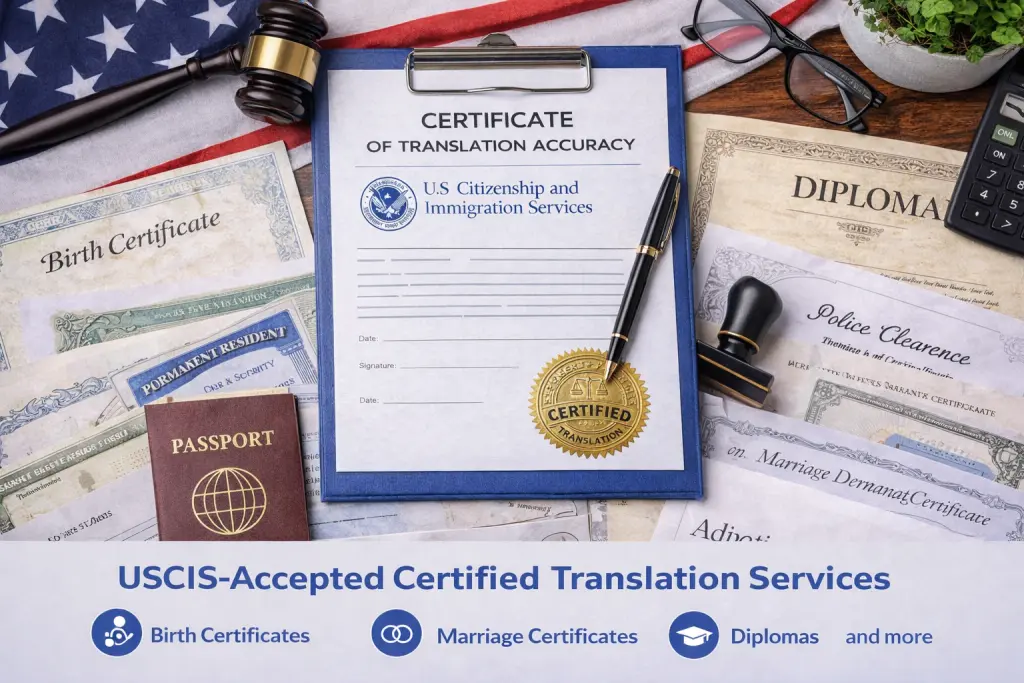
A certified translation services in the United States consists of three distinct components: the original source-language document, the translated target-language text, and a signed statement from the translator or translation company representative that attests to the translation’s accuracy and completeness. .
The translator who completes the work can certify it, or another qualified translator can certify it after reviewing the translation for accuracy. Translation companies certify translations provided by their employees or freelance contractors, so this flexibility allows you to access professional services whether you’re searching for document translation services near me or working with online providers.
The certification statement and translator credentials
Your certification statement must include specific elements to meet institutional requirements. You need these at minimum:
- A statement of the translator’s qualifications and competence in both languages
- An affirmation that the translation is complete and accurate
- Identification of the translated document and languages involved
- The translator’s name, signature, and date
The American Translators Association established its certification program in 1973 to provide a framework to recognize professional-quality work. ATA certification remains one of the industry’s most respected credentials for translators and is the only measure of competence for translation that more people recognize in the U.S.. But a translator doesn’t need ATA certification to provide certified translations. Many excellent translators work in language pairs where no certification exam exists.
When you need certified translations
You’ll need certified translation services when submitting documents to government entities, legal proceedings, or educational institutions. Immigration applications require certified translations of birth certificates, marriage certificates, police records, and diplomas.
Legal proceedings, both civil and criminal, demands certified translation services. Universities require foreign candidates to submit certified translations of application documents that include transcripts and diplomas. The translation must be exact, word-for-word, and legible. Institutions cannot accept handwritten translations, translations of photocopies, translations completed by applicants themselves, or incomplete translations.
Immigration Use Cases for Certified Translations
Visa and green card applications
Federal regulations mandate that any document containing foreign language submitted to USCIS must be accompanied by a full English language translation certified as complete and accurate. Most applications require this, such as naturalization applications, adjustment of status (Form I-485), family petitions and employment-based visas. You submit untranslated foreign-language documents and your case gets delayed or denied. USCIS officers have the authority to reject applications that don’t meet translation standards. You could face application delays, Requests for Evidence (RFE) extending processing time by months, or outright denial.
Birth certificates and marriage documents
Your birth certificate verifies your identity for almost every U.S. immigration application. USCIS requires a copy of your foreign birth certificate with a certified English translation to establish your country of citizenship, identity and existence of derivative relationships. Marriage certificates prove your relationship status for family-based petitions and spousal sponsorships. You or your spouse were previously married and you’ll also need divorce decrees or death certificates with certified translations. Each document must have every word, stamp and seal translated. This covers marginal notes, official stamps and handwritten annotations.
Academic transcripts and diplomas
Academic records appear often in employment-based cases, student-related matters and supporting evidence for eligibility. You’ll need certified translations for diplomas and transcripts when applying for work visas that require specific educational qualifications. The translation must be complete and has all grades, dates, titles, signatures and watermarks while maintaining the structure and layout of the original.
Professional licensing boards for nursing, engineering, accounting and teaching require certified translations because eligibility decisions depend on course titles, credit hours and degree conferral dates.
Court documents and legal records
Immigration courts require certified translations for all foreign-language documents filed. You must submit original or court-certified copies of arrest records and court dispositions if you’ve been arrested. Police records, affidavits, declarations and sworn statements all require certified translations for court proceedings. The certification must specify the documents being translated and have the translator’s address and telephone number.
Business Applications Requiring Certified Translations
Corporate registration and licensing
Certified translation services become necessary when you expand into foreign markets for your business licenses and operating permits. Articles of incorporation, certificates of formation, corporate bylaws, and shareholder agreements in foreign languages need certified translations for U.S. regulatory filings, business license applications, and international transactions. Commercial registrations and trade licenses must include accurate legal equivalents for your company’s legal form. You need to translate LLC, JSC, or Partnership correctly rather than use literal translations that confuse organizational structure. Entity formation procedures with government bodies require proof of your legal entity through translated documentation.
International contracts and partnerships
Certified translation services ensure your international business contracts meet both linguistic and legal standards for enforceability across jurisdictions. Courts and government agencies recognize these translations as legally valid, and so do international business partners. Partnership agreements, agency contracts, and distribution agreements with foreign parties require certification to enforce legally.
Financial statements and tax documents
Balance sheets and income statements require certification when submitted to U.S. regulatory bodies, along with cash flow statements and auditor’s opinions. Foreign tax returns submitted to the IRS or included with affidavits of support (Form I-864) must be translated and certified. Figures must match exactly. Zero tolerance exists for omissions or interpretive language.
Regulatory compliance documentation
Regulatory submissions to the SEC, IRS, or state banking departments must meet specific standards. Filing rejections and compliance violations can result from translations that lack proper certification.
Selecting Professional Translation Services for Your Needs
Look for providers with proven track records in handling immigration paperwork and business filings. Services specializing in USCIS submissions have translated hundreds of thousands of documents and understand exact formatting requirements. Their familiarity with agency-specific standards reduces rejection risk.
Language expertise and native speakers
Native speakers of the target language should complete your translation. Professional services maintain teams of thousands of native speakers in language pairs of all types. This will give cultural nuances and terminology the correct handling.
Document translation services near me vs online providers
Local services give in-person consultations and understanding of state-specific requirements. Online platforms provide 24/7 accessibility, transparent pricing calculators and faster turnaround times. Online services often cost less due to lower overhead while maintaining quality. Online providers access global talent pools more easily when dealing with rare language pairs.
Quality assurance and revision policies
Professional services implement systematic quality assurance processes throughout translation. Quality control has multiple review stages. Both translators and subject matter experts check translations. Request providers offering unlimited revisions to ensure complete satisfaction.
Why choose USCIS Translation Services for immigration documents
USCIS Translation Services offers certified translation services at a very affordable price with a 24-hour turnaround. Each translation has a formal certificate of accuracy meeting USCIS and court requirements, with optional notarization available.
Most certified translation services complete translations within 24 hours. Turnaround depends on word count, language complexity, and translator availability. Expedited certified translation services prioritize your order and reduce delivery time by up to 50%, making them ideal for urgent government submissions.
Conclusion
Certified translation services protect your immigration applications and business filings from rejection. Qualified services that understand USCIS standards and regulatory requirements save you time and prevent delays that get pricey. You might need birth certificates translated for your green card application. Or maybe financial statements certified for regulatory compliance.
Professional services ensure your documents meet exact specifications. Verify the provider’s experience with your specific document type first. Then confirm they include certification statements that government agencies will accept without question.
FAQs
Q1. Is certified translation mandatory for USCIS applications?
Yes, it is mandatory for all foreign-language documents accompanying immigration applications. Without proper certification, your application will be delayed or rejected, even if your translation is accurate. The translation must include a statement that attests to its accuracy and completeness.
Q2. What makes a translation “certified” in the United States?
A certified translation services consists of three parts: the original document, the translated document, and the translator’s certification. The translator’s certification must include qualifications, accuracy, document description, languages used, translator’s signature, and date. The United States does not have any licensing requirements. Anyone with qualifications is eligible for providing certifications.
Q3. Why is translation accuracy crucial in business or legal documents?
Translation accuracy is crucial in business or legal documents because it is essential for effective communication of intentions, obligations, or rights. It also builds trust with your clients or business associates by helping avoid misunderstandings. Financial documents, in particular, cannot have any inaccuracies or errors, which may result in document rejection or legal disputes.
Q4. Can I translate my own documents for immigration purposes?
No, you cannot translate your own documents for immigration purposes. Immigration agencies demand that your documents be translated by any other person. The translator’s certification must include qualifications in both languages and accuracy.
Q5. How does translation assist businesses in their global expansion?
Translation is extremely helpful in business because it enables effective communication with people of diverse languages. A business can translate its documents into languages preferred by its customers. This enables businesses to build stronger customer relationships. For business expansion, translation is extremely crucial in legal documents